
From Co-Design to Connection: Family Storytelling and Neurodiversity in Collaboration Station
What if research began with stories instead of surveys? Collaboration Station is a virtual living lab, co-designed with families to be an interactive platform, a place for families to connect, and a place for researchers to reimagine how we understand family lived experiences through storytelling.
Families of children and youth with neurodevelopmental differences know how complex it can be to navigate health, education, and community systems. Yet their voices are often missing from the research meant to inform those systems. To help bridge this gap, Dr. Mandy Archibald and her team created Collaboration Station in 2019 through a collaborative, step-by-step co-design process with families, clinicians, researchers, and technologists. I joined Dr. Archibald’s Amplify Lab as the Research Coordinator for Collaboration Station in August 2025 and have learned how powerful and unique storytelling can be. It’s exciting to be part of a project that approaches research differently by listening first to families and learning from their stories.
In our early work, we learned that families preferred storytelling as a way to share their experiences (Archibald et al., 2024). Collaboration Station draws on the F-words (aka Favourite words) Framework (family, function, fitness, friends, fun, and future), an adaptation to the World Health Organization’s International Classification of Functioning, Disability and Health (Rosenbaum & Gorter, 2011). The F-words are interesting because they offer a positive, holistic way to think and talk about child development. When families publish their stories on Collaboration Station, they can choose from all six F-words and tag the ones that feel most applicable to their story.
Collaboration Station brings together storytelling and art to exchange knowledge, build community, and connect research efforts with lived experience. Our next step is to co-create a knowledge translation platform in Collaboration Station, informed by the findings I am sharing today, and as a way to share out more creative resources.
So far, 22 stories have been shared on Collaboration Station by families (children, their siblings, parents or guardians) all publicly available for anyone to view. Of these stories, 16 were written by parents or guardians and 6 by children or youth. The stories range from 127 to 989 words, averaging about 447 words, which we think makes for some pretty rich storytelling! When we looked at how families tagged their stories with the F-words, Function came up most often, followed by Family and Fun, while Fitness and Future appeared much less frequently.
We also took a closer look at the stories themselves to better understand families’ experiences alongside the lens of the F-words framework. From this, we developed three main themes that reflect the importance of incremental goal setting and the meaning-making that takes place in family life. This work will be submitted for publication soon!
This is the first study within Collaboration Station, and we have learned a great deal about family's experiences but also about how to improve the platform. Next, we plan to reopen Collaboration Station to welcome both new and returning families, grow our story collection and family registry, and explore the less represented F-words (fitness, future) to co-design support in that area.
A Masters of Nursing student in the Amplify Lab is currently conducting usability testing of the platform, which we will use to refine its features. We aim to expand Collaboration Station to capture more experiences, looking to different communities within and beyond Manitoba. We are excited for what’s ahead as the platform continues to grow as a space for sharing, creativity, and innovation!
This work was made possible with the generous support of our funders: The Winnipeg Foundation Rady Health Sciences Innovation Grant, the PREPP Award from the George & Fay Yee Centre for Healthcare Innovation, and Research Manitoba. We are also so grateful to our community partners at the Specialized Services for Children and Youth Centre, the Rehabilitation Centre for Children, and the Children’s Hospital Research Institute of Manitoba.
If you would like to explore Collaboration Station, visit our website at collaborationstation.umanitoba.ca. To learn more, ask questions, or get involved in future Collaboration Station projects, you can reach out to Dr. Mandy Archibald at Mandy.Archibald@umanitoba.ca.
Published December 1, 2025
-
Archibald, M. M., Akinwale, O., Hammond, E., Mora, A., Woodgate, R. L., & Wittmeier, K. (2024). A Living Lab for Family Centered Knowledge Exchange in Pediatric Rehabilitation and Development Research: A Study Protocol. International Journal of Qualitative Methods, 23. https://doi.org/10.1177/16094069241244866
Rosenbaum, P., & Gorter, J. W. (2011). The ‘F‐words’ in childhood disability: I swear this is how we should think! Child: Care, Health and Development, 38(4), 457-463. https://doi.org/10.1111/j.1365-2214.2011.01338.x
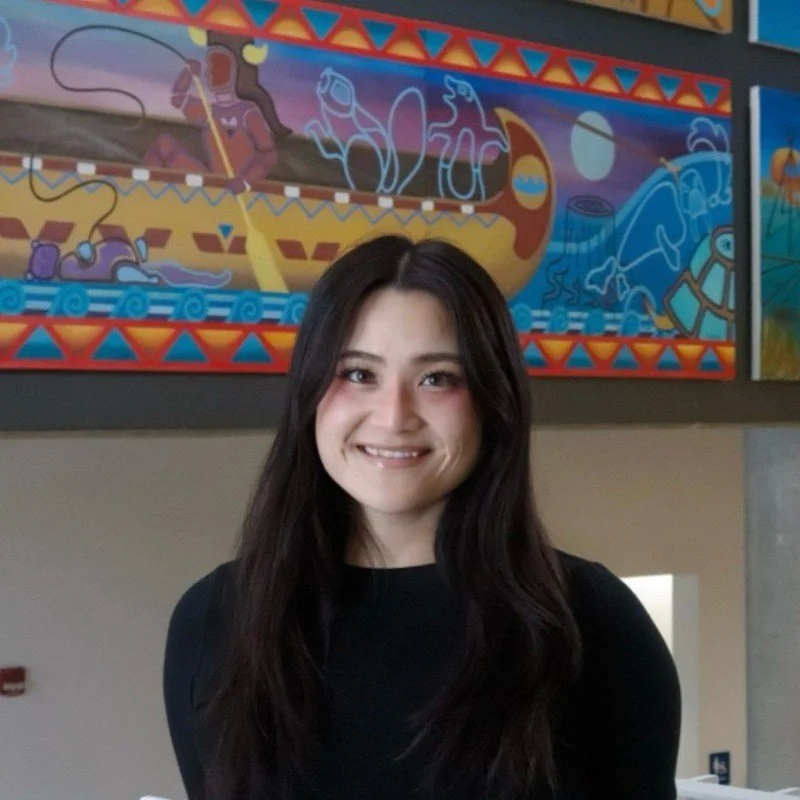
ABOUT THE AUTHOR
Amy Abegglen (she/her)
Amy is completing her Master’s in Kinesiology and Recreation Management at the University of Manitoba, supervised by Dr. Todd Duhamel. Her research explores how family caregivers engage in and understand early mobilization in the cardiac surgery intensive care unit at St. Boniface Hospital. Alongside her graduate studies, Amy works as the Research Coordinator for the Collaboration Station projects in the Amplify Lab. Her broader interests focus on patient- and family-centered care, and on understanding the lived experiences and priorities of families to better support them in healthcare and rehabilitation.